New financing platform targeting nine border states forms centrepiece of Commission strategy to address economic and security strain.
The European Commission has launched a new financing platform to mobilise at least €28 billion in investment for EU member states on the bloc’s eastern border, as Europe steps up efforts to address the economic and security consequences of the Russian war in Ukraine.
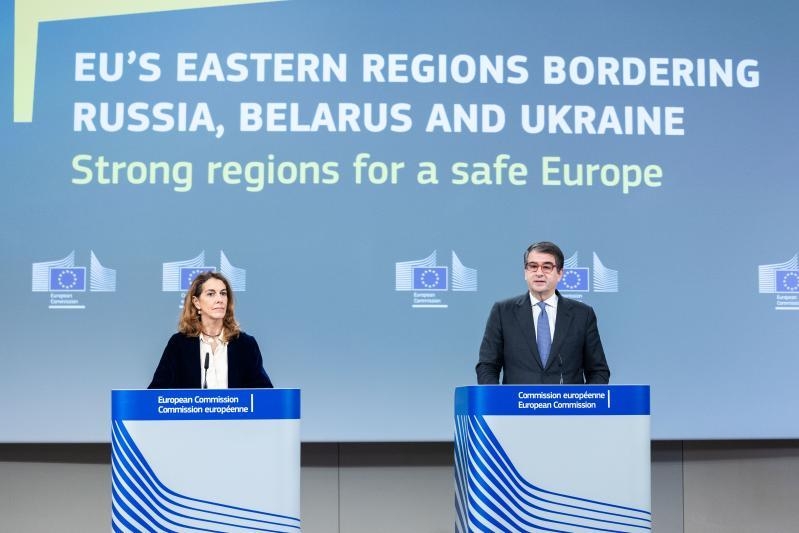
The EastInvest Facility was launched at a high-level conference in Brussels opened by Commission President Ursula von der Leyen and hosted by Executive Vice-President Raffaele Fitto in February.
The platform brings together several major development banks of the region, including the European Investment Bank Group, the European Bank for Reconstruction and Development, the Nordic Investment Bank, the Council of Europe Development Bank, and national promotional banks from nine eastern Member States: Finland, Estonia, Latvia, Lithuania, Poland, Slovakia, Hungary, Romania and Bulgaria.
The participating institutions estimate the facility will mobilise at least €28 billion in public and private investment across those regions. EIB President Nadia Calviño said the bank financed €14.5 billion in investment across the nine countries last year, up 16% year-on-year.
The facility aims to mitigate the economic and social impact of the war while improving access to financing for infrastructure, trade and security-related projects in eastern regions. It will support investment in transport and energy infrastructure, alongside broader priorities including digital connectivity, defence capabilities and dual-use transport links.
The initiative forms the centrepiece of a wider Commission strategy, adopted on 18 February, titled ‘Strong Eastern Regions for a Safe Europe’.
The financing platform comes as military spending across Europe accelerates sharply. European NATO members’ total military spending reached $559 billion in 2025, with European defence expenditure up 14% overall and 23 of 32 NATO members now meeting the 2% of GDP threshold, according to SIPRI.
Among the facility’s target countries, Poland increased defence spending by 23%, Finland’s budget rose 17% to reach 2.6% of GDP, and Romania spent $9.7 billion on defence, equivalent to 2.3% of GDP — figures that illustrate the mounting fiscal pressure the facility is designed, in part, to help absorb.
Eastern border regions have faced trade disruption, population decline from border closures and sanctions-related impacts since Russia’s invasion. The Commission said the facility will complement existing EU funding instruments, with annual reviews to track progress.