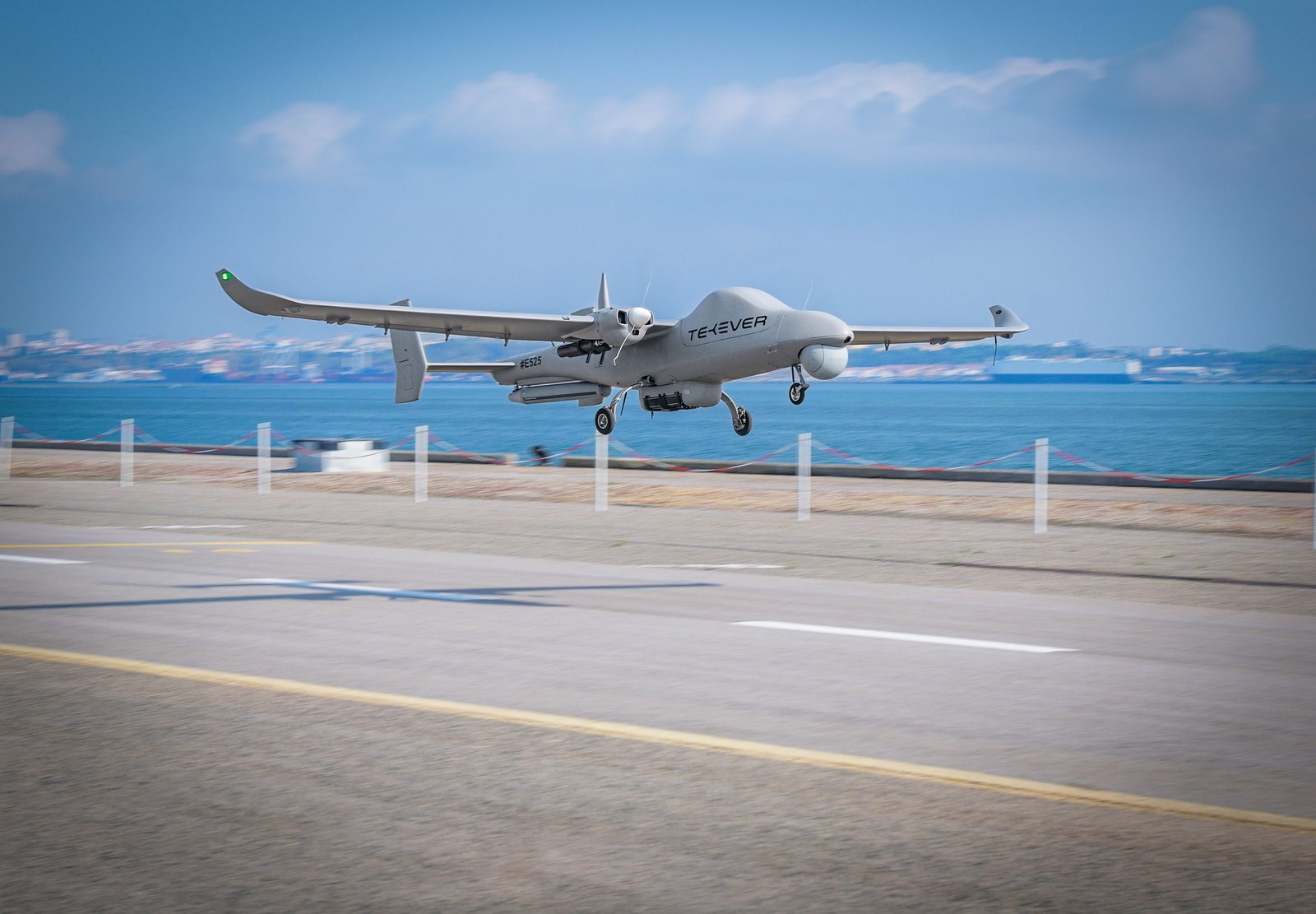
TEKEVER, the Portuguese-founded maker of surveillance drones, has set up a German subsidiary in Munich, three weeks after announcing the first close of a $580m (€510m) Series D at a $6.4bn valuation.
The company said on 13 October that TEKEVER Germany would be its headquarters for Germany, Austria and Switzerland, covering engineering, business development and customer work. It did not give an investment figure, headcount or any plan for production in Germany. Recently, the Bundeswehr has taken delivery of a TEKEVER heavy-lift drone, which it is evaluating for logistics and force-support work, the company said. The German expansion follows TEKEVER’s £400m investment programme in UK and a €200m commitment in France.
UC Investments, which manages the University of California’s $190 billion endowment and pension assets, led the Series D in its first direct investment alongside Baillie Gifford. Merlyn Advisors, where former UK defence secretary Sir Ben Wallace is a portfolio manager, joined as a new investor. Existing shareholders Crescent Cove, Ventura Capital and Iberis Capital also invested.
TEKEVER said the first close covered the majority of the round, and it expects further closes in the coming months to bring in new investors. This follows a May 2025 round led by Ventura Capital that valued the business at more than than £1bn.
Ricardo Mendes, TEKEVER’s founder and chief executive, told Bloomberg on 23 September that the round was designed to fund acquisitions as well as organic growth. He said he expected “tremendous consolidation” in defence technology over the next few years which has experienced a proliferation of startups. In an interview published by Baillie Gifford with Mendes this summer, the CEO said TEKEVER would do “a lot more M&A” this year and wanted to add maritime, land and counter-drone products to its aircraft, adding that an IPO was very likely and that the company was already preparing for one.
TEKEVER is also undergoing inorganic growth, having bought Flowcopter, an Edinburgh company that makes hydraulic transmission systems for drone propulsion, in September. Flowcopter was already a development partner on TEKEVER’s AR6 heavy-lift drone, which the company says can carry at least 200kg over 500km and is due to enter production in Swindon by the end of 2026. Terms were not disclosed. It was TEKEVER’s second UK acquisition, after it bought West Wales Airport at Aberporth in July 2025 to use as a drone test site.
Baillie Gifford has doubled down on its investment in TEKEVER, having co-led the Series D after leading its €70m Series B round in 2024 which included support from the NATO Innovation Fund. Baillie Gifford’s Schiehallion Fund, a London-listed investment trust that buys stakes in later-stage private companies, lists TEKEVER as its fourth-largest holding, at 7.3 per cent of total assets of $2.57bn, according to its latest factsheet. That is up from 3 per cent at the end of October 2025.
The TEKEVER round adds to a run of large and recent raises by European defence drone companies. According to Dealroom, drone companies have raised $4.7bn across 40 European rounds in the first nine months of 2026, which accounts for nearly two-thirds of the $7.4bn raised by European defence start-ups over the period. Standouts include Munich-based Helsing, which raised $1.8bn at an $18bn valuation in July, and Cambridge Aerospace, which raised $300m at a $3.4bn valuation in August.
Unlike these fairly new peers, TEKEVER is unusual in the latest defence tech fundraising wave as it was founded well before the Ukraine-Russian war, back in 2001. Its drones carry out intelligence, surveillance and reconnaissance (ISR) work for military customers, as well as maritime and border surveillance, and the company says its systems have operated in Ukraine since 2022. In September it signed a contract with the UK Ministry of Defence to supply CORVUS, a British Army surveillance programme worth up to £400m over 10 years.
TEKEVER and UC Investments did not respond to a request for comment.