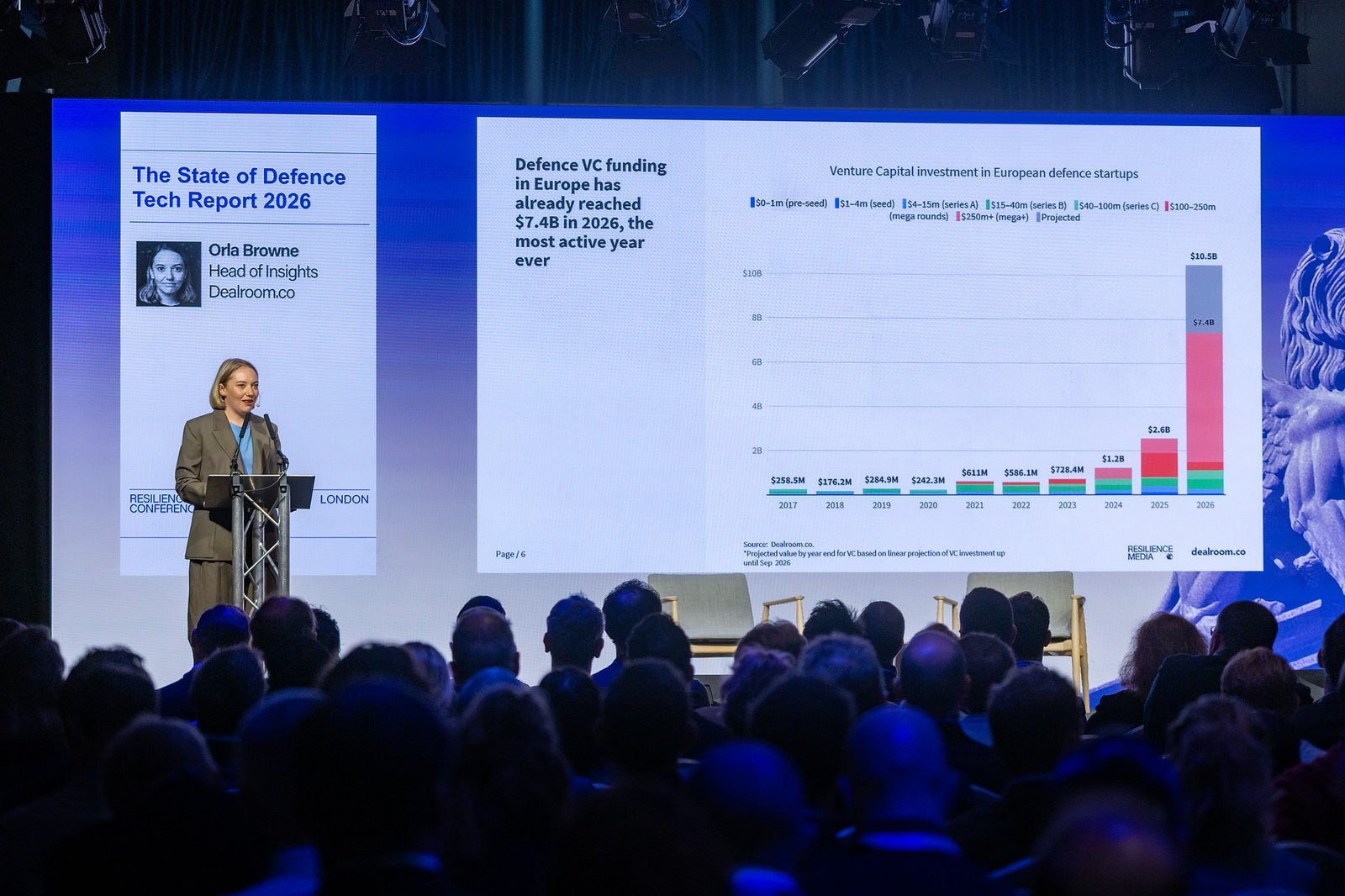
Venture capital (VC) investment in European defence start-ups reached a record $7.4bn (about €6.6bn) in the first nine months of 2026, nearly three times the $2.6bn raised in the whole of 2025, according to a report by Dealroom and Resilience Media this month. Dealroom projects the total will reach $10.5bn by the end of the year if investment continues at the same pace.
Defence is now the fastest-growing major segment of European VC, the report found, and accounts for 11.1 per cent of all venture investment in Europe, rising to 15 per cent in the EU. European venture-backed defence start-ups are now worth a combined $44bn, with 77 per cent of that value in companies founded since 2020.
For the first time, US investors have overtaken European investors, supplying 47 per cent of European defence tech funding so far this year, up from 17 per cent in 2020. The share of European investors has fallen to 44 per cent.
European defence venture capital by year
Venture capital raised by European defence start-ups, $m. 2026 shows funding to September plus Dealroom’s projection for the rest of the year.
Source: Dealroom and Resilience Media, The State of Defence Tech 2026 (data to September 2026)
A few large rounds weigh heavily in that figure however. Rounds over $100m made up more than 85 per cent of this year’s total, and US capital was in each of the four largest: Munich-based Helsing’s $1.8bn Series E in July, led by Lightspeed with Dragoneer also investing (and valued the defence AI and drone maker at $18bn); Quantum Systems’ €1bn Series D, raised the same month with backing from Blackstone and Advent; ICEYE’s €1bn round drew General Atlantic and TCV; Stark raised €500m in June from investors including Founders Fund and Sequoia.
While US capital is now more prominent, some European investors argue the region needs its own capital to keep pace and sovereignty.
“Europe’s military leaders have been clear with us: if we want to build and retain critical defence capabilities in Europe, we also need sovereign European financing. The demand for these technologies is there and now the capital must follow,” Klaus Hommels, founder and chairman of Lakestar, said in a statement. Lakestar is the second most active investor in European defence start-ups since the start of 2025 by number of rounds, and closed its $300m Resilience I fund in July.
The investor base is widening too. Dealroom counted 455 investors taking part in at least one European defence deal this year, four times the 114 in 2020. Specialist defence funds joined a quarter of rounds, up from 18 per cent in 2025 and 12 per cent in 2024, after a record 22 dedicated defence funds launched in Europe last year. The ten most active investors have made 75 investments between them since the start of 2025, led by the NATO Innovation Fund with 12 and Lakestar with 10.
Germany remains the largest market by some distance. German start-ups raised $3.5bn this year and $5.9bn since 2020, driven by Helsing, Quantum Systems and Stark, which raised €500m in June, and Munich alone took 40 per cent of European defence funding in 2026. Finland was second this year with $1.2bn, largely from ICEYE, ahead of the UK at $932m, where the largest rounds went to Cambridge Aerospace and Kraken Technology.
EU start-ups are also growing faster than the wider market, with defence venture funding doubling to $5.4bn. Compared to the broader NATO and allied countries market, however, this equates to 21 per cent of the total $27.1bn. Three quarters of funding remains in the US.
In terms of exits, activity is finally expected to pick up this year as investments come to maturity. Between 2021 and 2024, defence start-ups across NATO and allied countries averaged about eight per year. Dealroom projects 31 exits this year.
Despite the rapid and widespread growth of the European defence tech sector, concerns remain about if and how investments will actually translate into tangible changes in military capability.
“It’s reassuring to see European investment responding to the current threat environment. But this isn’t turning into deployed capability fast enough,” Harry Mead, co-founder of national security start-up Augur, said.
(Photo credit: Resilience Media 2026)