Greece became the fifth country to draw down money under the European Union’s SAFE defence financing programme on 23 July, receiving €118.2 million — 15% pre-financing of a €787.7 million allocation. It’s a small sum against the scheme’s headline size, but it’s a useful marker for how quickly, and unevenly, the EU’s biggest-ever defence financing tool is starting to move.
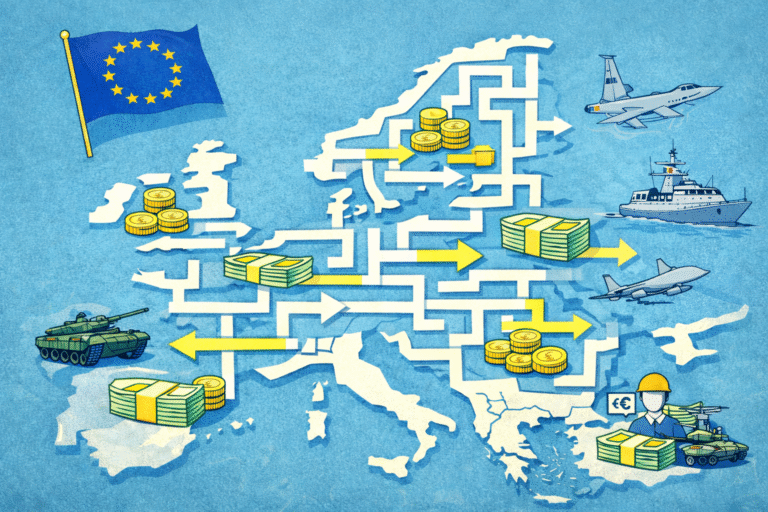
SAFE — Security Action for Europe — was agreed by EU governments in May 2025 as the centrepiece of the Commission’s Readiness 2030 plan, which aims to unlock more than €800 billion in European defence spending by the end of the decade. Unlike most EU spending, SAFE isn’t a grants pot. The Commission borrows up to €150 billion on international capital markets using the EU’s own credit rating, then re-lends it to governments, who pay it back over long terms with a 10-year grace period before repayments start. This is the same borrowing model the EU used for its Covid-era recovery fund, NextGenerationEU, aimed at defence industry instead of stimulus.
Demand was immediate and heavy. Nineteen of the EU’s 27 members asked to take part, and combined requests came in above the €150 billion on offer.
The Commission set tentative country-by-country allocations in September 2025 and asked governments to submit detailed national defence investment plans by the end of November.
The first batch of plans — for Belgium, Bulgaria, Denmark, Spain, Croatia, Cyprus, Portugal and Romania, worth roughly €38 billion between them — got the green light in mid-January 2026, with a second group including Greece, Italy, Poland and the Baltic states following soon after.
Approval of a plan doesn’t mean money moves straight away — governments still have to sign a loan agreement before they can draw down pre-financing, capped at 15% of their allocation.
That’s why the disbursements have trickled out over months rather than landing all at once: Poland first, on 29 May, with just over €6.5 billion — by far the largest slice so far. Cyprus (€177 million), Lithuania (€956 million) and Croatia (€255 million) followed through June and early July, before Greece’s payment this week. Altogether, around €8 billion has now reached five countries.
Italy’s plan, one of the largest at €14.9 billion, has been approved but is still waiting on a signed loan agreement before any cash can move — a reminder that approval and disbursement are two different milestones, and that the biggest sums are still to come.
The loans come with strings attached. To qualify, participating countries generally have to run joint procurement involving at least two SAFE members, a rule designed to push governments toward buying together rather than duplicating national programmes, and to help consolidate Europe’s fragmented defence industry.
The scheme also allows bilateral agreements bringing in non-EU partners, and was designed in part to help fold Ukraine’s defence industry into European supply chains.
How strictly the “built in Europe” procurement rules get applied in practice is still an open question. Greece is reportedly looking at using part of its allocation toward a roughly €3.5 billion purchase of Israeli air-defence systems — a Commission spokesperson declined to confirm or deny it when asked. That presents a live test of how much flexibility exists inside a programme explicitly designed to grow European industrial capacity.
For now, the pattern is clear enough – money is moving, but slowly and unevenly, gated by a multi-step approval process rather than a single starting gun.
The more telling numbers over the next few months won’t be individual country payments like Greece’s, but whether the larger allocations — Italy’s €14.9 billion chief among them — start converting into signed agreements and real disbursements.