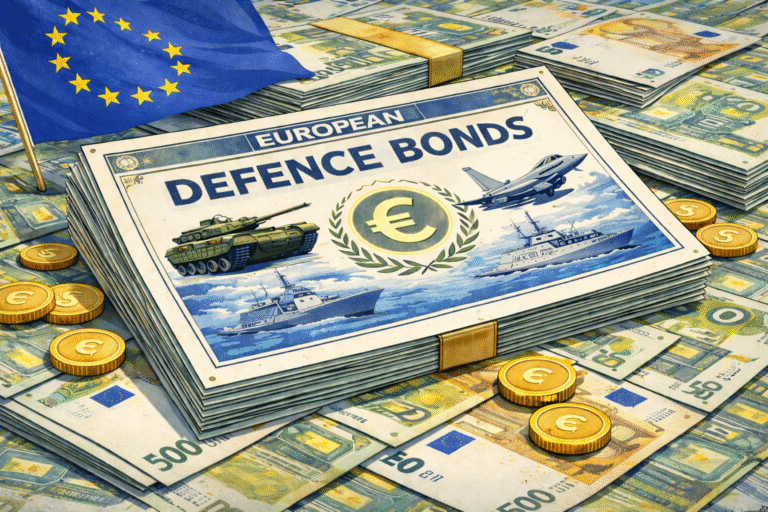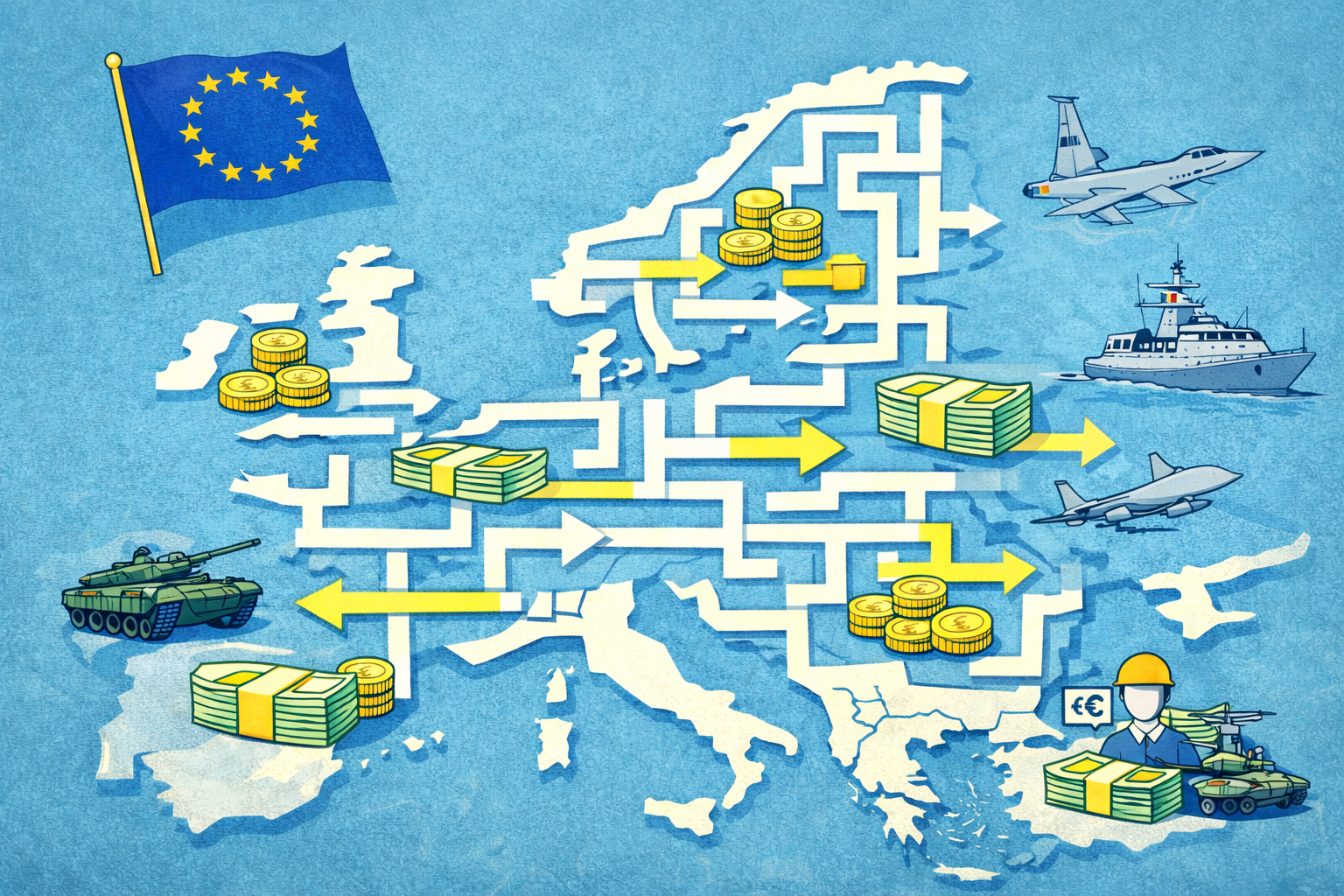
From SAFE to ASAP, a guide to the EU’s overlapping defence funding initiatives, showing how money flows, who can access it, and what it means for investors and contractors.
Brussels has launched a range of defence funding initiatives since Russia’s 2022 invasion of Ukraine, creating a complex landscape for investors, contractors, and dare we say it… policy makers too.
Here’s what you need to know to understand each initiative.
The big picture: ReArm Europe
The overarching framework is ReArm Europe, the European Commission’s plan to mobilise €800bn in defence investment by 2030. This isn’t a single fund but a strategic umbrella set out by Europe’s executive body, the Commission, covering multiple financing mechanisms, regulatory reforms and fiscal flexibility measures designed to rebuild Europe’s military-industrial capacity.
Think of it as Brussels’ answer to the question: “How do we fund European defence without blowing up the EU budget?” The answer involves creative accounting, joint borrowing, redirected civilian funds and off-budget mechanisms.
The core funds
European Defence Fund (EDF) — €7.3bn (2021–2027)
The flagship. Launched in 2021, the EDF provides grants for collaborative defence research and development across EU member states. It’s split roughly one-third research, two-thirds development, with grants typically covering 80–100 per cent of project costs.
The catch: Projects must be genuinely collaborative, involving entities from multiple member states. Solo national projects need not apply. The EDF has committed €5.4bn to date across 162 programmes, with the average project involving 17 entities from different countries.
Key detail for contractors: Ukraine was formally associated with the EDF in November 2025, allowing Ukrainian defence firms to join consortia competing for grants.
Security Action for Europe (SAFE) — €150bn
The new heavyweight. Approved in May 2025, SAFE is a loan facility—not grants—enabling joint borrowing by EU member states to finance defence procurement. Member states can borrow up to €150bn collectively at competitive rates backed by EU bonds.
The restriction: Equipment financed through SAFE must source at least 65 per cent of components from the EU, EEA-EFTA states or Ukraine. This “buy European” requirement has sparked tension with non-EU suppliers, most notably the UK, which rejected Brussels’ proposed €6.75bn entry fee in November 2025.
Target areas: Drones, missiles, cyber-defence systems, maritime platforms and strategic enabler programmes.
Status: Member states faced a 30 November 2025 deadline to submit project plans. First disbursements expected in early 2026.
The emergency measures (now being phased out)
EDIRPA — €310m (2023–2025)
The European Defence Industry Reinforcement through Common Procurement Act was Brussels’ first foray into joint defence equipment procurement. It incentivises member states to buy urgently needed kit together—ammunition, air defence systems, armoured vehicles—by subsidising the added costs of cooperation.
Status: Expires end-2025, being rolled into EDIP.
ASAP — €500m (2023–2025)
The Act in Support of Ammunition Production funded 31 projects to double European artillery shell production to 2m rounds annually by end-2025. Direct grants to manufacturers for upgrading factories, expanding capacity and tackling supply chain bottlenecks.
Example: French firm Nexter received €41m to increase production capacity eightfold.
Status: Expires mid-2025, also being rolled into EDIP.
The next generation
European Defence Industry Programme (EDIP) — €1.5bn (2025–2027)
The successor to EDIRPA and ASAP. EDIP extends and expands the emergency measures with €1.5bn in grants running to 2027, bridging the gap until the next EU budget cycle begins in 2028.
EDIP aims to institutionalise joint procurement, improve supply chain responsiveness and includes €300m specifically earmarked for Ukraine support.
Status: European Parliament and Council reached provisional agreement in October 2025. Final approval expected before year-end.
The venture capital play
Defence Equity Facility — €175m
A joint initiative between the European Commission and European Investment Fund launched in January 2024. The €175m (€100m from EDF, €75m from EIF) acts as anchor capital for venture and private equity funds investing in European defence tech startups.
The model: EIF takes 7.5–25 per cent stakes in funds, aiming to crowd in private capital and mobilise roughly €500m total at the company level.
Deployments to date: €40m to Keen Venture Partners’ European Defence and Security Tech Fund (May 2025) and €30m to Sienna Hephaistos Private Investments, Europe’s first dedicated defence private credit fund (September 2025).
Target: Innovative SMEs and mid-caps developing dual-use technologies.
The off-budget workaround
European Peace Facility (EPF) — €17bn+ (2021–2027)
Technically not part of the defence industrial funding architecture, but impossible to ignore. The EPF is an off-budget mechanism—member states contribute directly based on GNI, bypassing EU budget restrictions on military spending.
It has two pillars: funding EU military missions abroad and providing military assistance to partner countries. For Ukraine alone, the EPF has committed €11.1bn since February 2022, including a dedicated €5bn Ukraine Assistance Fund established in March 2024.
Why it matters for investors: EPF funding flows don’t appear in EU budget figures but represent massive procurement activity, particularly in ammunition, air defence and heavy equipment.
The regulatory reforms
Defence Readiness Omnibus
Not a fund, but critical context. Proposed in June 2025, this package amends at least ten existing regulations to remove bottlenecks preventing rapid defence investment. Key measures include fast-track permitting for defence infrastructure, streamlined cross-border transfer of military equipment and broader exemptions from environmental regulations.
Mini-Omnibus
Agreed provisionally in November 2025, this redirects existing civilian EU funds toward defence. Five major programmes—STEP, Horizon Europe, Digital Europe, Connecting Europe Facility and cohesion funds—can now support defence and dual-use projects. Member states can voluntarily transfer unspent Recovery and Resilience Facility resources toward defence through 2027.
The angle: No new EU budget money, just creative repurposing of existing allocations. An estimated €210m in additional funding for dual-use innovation has been unlocked from previous Horizon Europe returns.
The access question
Who can participate?
Most EU defence funding restricts eligibility to entities established in:
- EU member states
- EEA-EFTA countries (Norway, Iceland, Liechtenstein)
- Ukraine (since November 2025)
- Potentially countries with EU Security and Defence Partnerships (e.g. UK, though terms remain contested)
The 65 per cent rule: Equipment and components must be predominantly European-sourced under most schemes, though definitions vary. Non-EU suppliers face significant barriers unless they establish European manufacturing presence.
The complexity: Different funds have different eligibility criteria, different application processes and different timelines. Contractors often need to participate in multiple schemes simultaneously to capture maximum value.
What it all means
For investors: European defence funding is fragmented across grants (EDF, EDIP), loans (SAFE), equity (Defence Equity Facility) and off-budget mechanisms (EPF). The venture capital opportunity sits primarily in the Defence Equity Facility and its mobilised private capital, while larger institutional investors should focus on SAFE-financed procurement programmes.
For contractors: Access requires navigating multiple overlapping schemes with varying eligibility rules. The shift from emergency measures (EDIRPA, ASAP) to institutionalised programmes (EDIP, SAFE) signals Brussels’ intent to make joint procurement permanent, not temporary. Companies unable or unwilling to meet European content requirements will find themselves increasingly locked out.
For policymakers: The proliferation of initiatives reflects political compromise rather than strategic coherence. Brussels is using every available lever—grants, loans, guarantees, off-budget funds, regulatory reform—because member states won’t agree to a single, large-scale defence budget. The result is effective but messy.
The bottom line
Europe is spending unprecedented sums on defence, but accessing that money requires understanding which acronym applies to your specific need. Welcome to Brussels.